


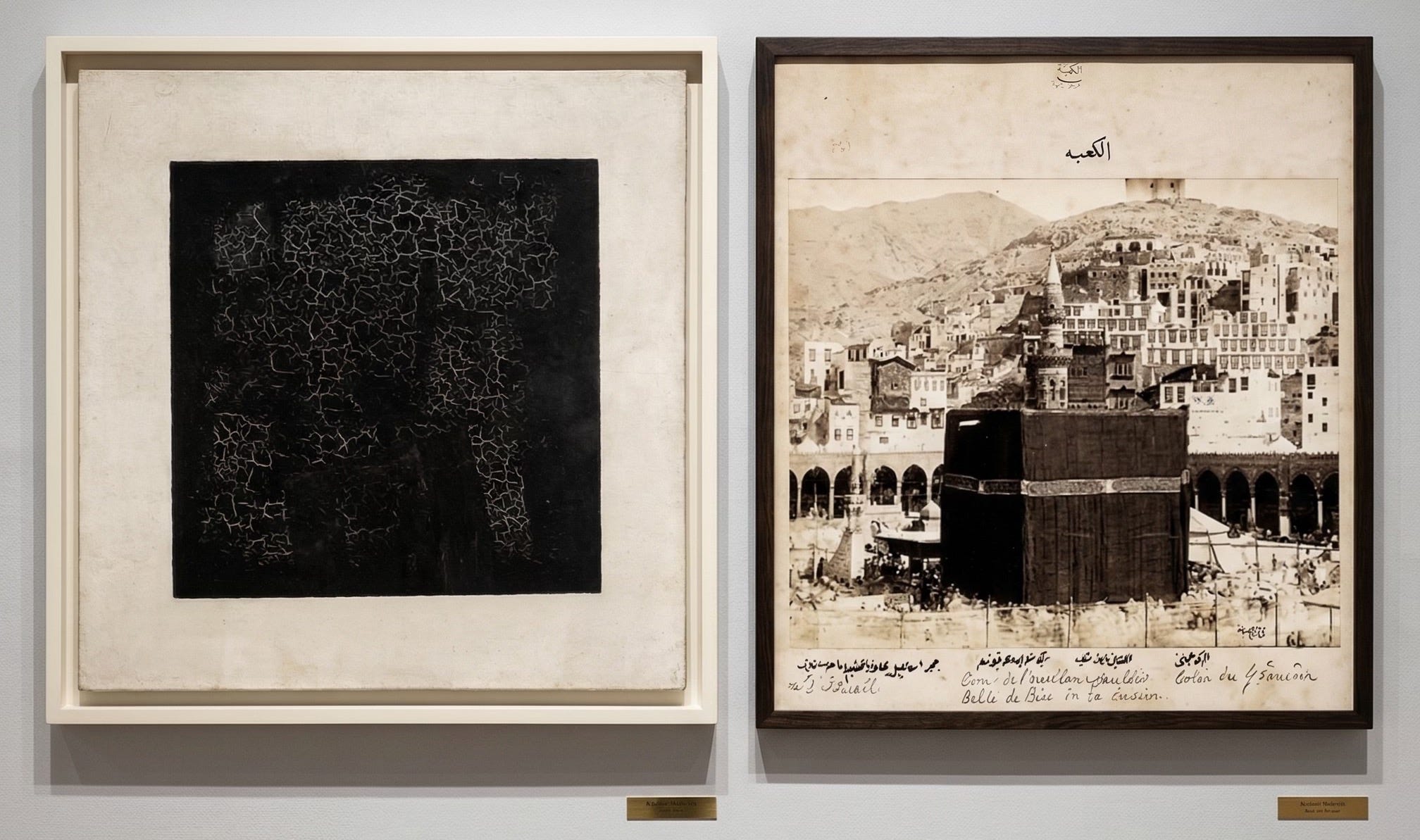
For once, O awaited Reality, Manifest in a material garb;
For a thousand prostrations lie quivering in my submissive brow.
When I put down my head in submission, a cry arose from the ground:
“Idols are sought by your heart; to what could your prayers amount?”
— Iqbal —
Malevich called his ‘Black Square’ the ‘absolute symbol of modernity.’ A modernity which, as Abdal Hakim Murad describes, “he hoped would be pure and spiritual, as opposed to the congealed decadence of 19th-century Western materialism.” The Black Square is “the total inversion of the Western tradition of recording the writhing diversity of the manifest world.” Malevich wrote later, in the words of Sh. Murad, “that when painting it he felt ‘black nights within’, and ‘a timidity bordering on fear’, but when he neared completion he experienced a ‘blissful sensation of being drawn into a desert where nothing is real but feeling, and feeling became the substance of his life.’” For Bruce Chatwin:
Mavelich’s ‘Absolute Symbol of Modernity’ “is the equivalent in painting of the black-draped Ka‘ba at Mecca, the shrine in a valley of sterile soil where all men are equal before God.’”
The princes of this sterile world we now inhabit would have us believe that:
In the beginning, there was nothing
And nothing happened to nothing
And nothing, for no reason, exploded and initiated everything.
And out of this everything, some things inexplicably started to replicate themselves;
And these replicating bits became whatever the hell we are;
But all we really are is just a bunch of atoms, clustered together,
In this gigantic optimisation problem,
Meaninglessly maximising entropy across time.
And that’s all there is to life.
And yet, reflecting on this darkness that has possessed our age, Malevich somehow, according to Sh. Murad, “stumbled upon the principle of pure beauty. Only the Real is real; manifestation and its diversities are chimera. The line between the two is razor-sharp: ‘Say: Reality has come, and falsehood has vanished; falsehood was ever evanescent.’ This was, after all, the ayah recited by the Prophet (s) as he rode around the Ka‘ba, pointing with his stick to each of the 360 idols in turn, upon which they fell over into the dust.”
Dust is what all idols must fall into. But neither man nor his world is just dust alone. For indeed;
Reality is One, be it dust or light
Sun’s blood gushes when Atom’s heart is striked!
— Iqbal —
Man must, therefore, search for Light, both within and without, unencumbered by the darkness he finds himself in. He must never despair; for, The Reign of Quantity is simultaneously, God-willing, The Twilight of Idols. However, The Eleventh Hour demands that he wields not Nietszchean hammers but ‘Alid two-pointed swords!
Bibliography:
Guénon, René. The Reign of Quantity and the Signs of the Times. Trans. Lord Northbourne. London: Luzac & Co., 1953.
Iqbal, Muhammad. “Kabhi Ae Haqiqat-e-Muntazir” (Bang-e-Dra, poem 169). 1924.
Iqbal, Muhammad. “Tulu-e-Islam” (Bang-e-Dra, poem 163). 1924.
Lings, Martin. The Eleventh Hour: The Spiritual Crisis of the Modern World in the Light of Tradition and Prophecy. Cambridge: Archetype, 1987.
Murad, Abdal Hakim. “The Sunnah as Primordiality.” 1999. masud.co.uk.
Nietzsche, Friedrich. Twilight of the Idols. Trans. R.J. Hollingdale. London: Penguin, 1968.