

But ... but they are Shia!
Yea coz Trump's Sunni innit

One your nation’s weal, one too the woe you share;
One your prophet, one his way: the same Truth you all declare;
One your Kaʹba, One your God, one your Quran as well;
So one in all — yet one in selves, was that too much to dare?
— Iqbal —
A Shia mosque gets bombed and a certain kind of Sunni scrolls past. A Sunni village gets levelled and a certain kind of Shia shrugs. Then Trump threatens to flatten Tehran and the same people who couldn’t locate Qom on a map suddenly remember that Iran is Shia. As if that settles anything. This is ta’aṣṣub: the reflexive arbitrist group-impulse that at best shuts down dialogue and at worst lets you cheer the bombing of people who pray toward the same Kaʹba as you.
Freud (لعنة الله عليه) had a phrase for it — the narcissism of small differences — the cruel fact that the closer two groups stand to one another, the more ferociously they need to invent a chasm between them. And underneath the ferocity, almost always, is ignorance. We mock what we don’t understand, and we hate most fluently what we’ve never bothered to learn.
So before any of the polemics — before the takfir, before the rafidi slurs, before the smug little “you’re Shia innit! All Shia are kuffah!!!” — it’s worth actually looking at what Sunnism and Shi’ism are, and at the strange, beautiful symmetry by which each tradition has, over centuries, grown the other inside itself. That’s what this piece is about.
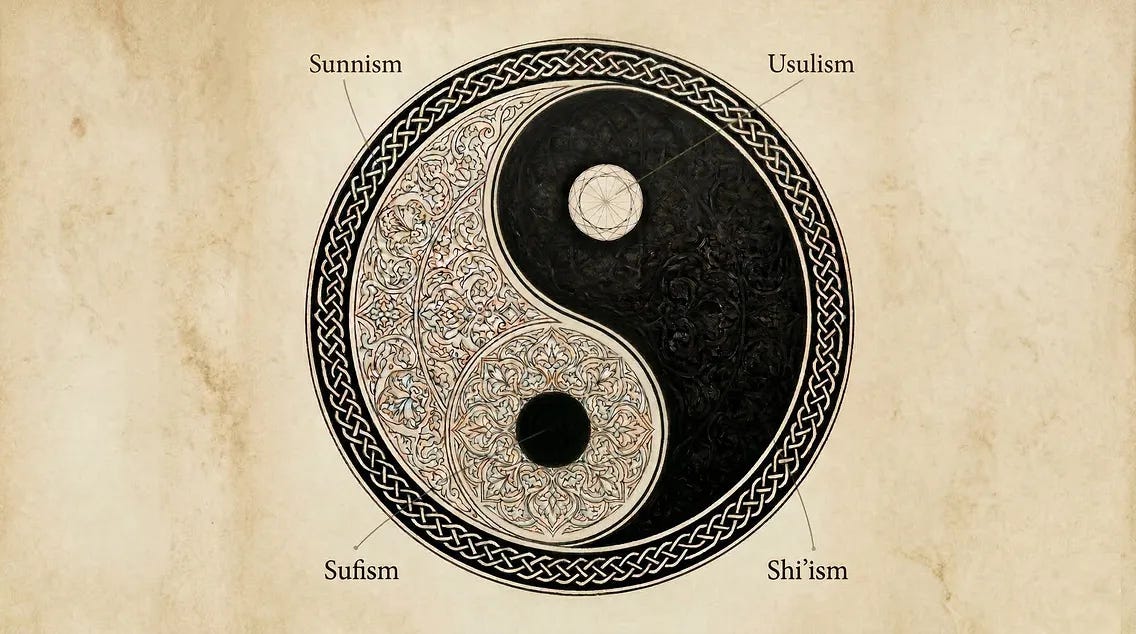
Islam has both an exoteric (zahir) and an esoteric (batin) dimension, which along with all their inner divisions represent the ‘vertical’ structure of the revelation. But it is also divided into Sunnism and Shi’ism, which one might say represent its ‘horizontal’ structure... But as a matter of fact the esoteric dimension of Islam, which in the Sunni climate is almost totally connected with Sufism, in one way or another colours the whole structure of Shi’ism in both its esoteric and even its exoteric aspect.
One can say that Islamic esotericism or gnosis crystallized into the form of Sufism in the Sunni world while it poured into the whole structure of Shi’ism especially during its early period.
— Seyyed Hossein Nasr —
If the batin crystallized into a distinct form within the exoteric world of Sunnism as Sufism, one might ask whether there is a parallel ‘sedimentation’ in the other direction: the zahir assuming a distinct, concentrated form within the esoterically pervaded world of Shi’ism. The answer, I think, is Usulism. The rationalist-juridical methodology that developed over centuries and achieved dominance when Bihbahani defeated the Akhbaris in the late eighteenth century. It represents the exoteric asserting itself as a recognizable presence within a tradition whose founding impulse is gnostic, just as Sufism is the esoteric asserting itself within a tradition whose governing impulse is legal.
The two processes are not temporally symmetrical though. And this asymmetry emerges from an essential asymmetry, or rather complementarity, between the zahir and the batin.
Sufism has roots in the first Islamic century; Usulism only begins to take shape centuries later. In Sunnism, the batin had to organize itself early or risk being lost within the exoteric whole. In Shi’ism, the zahir did not need its own distinct form for as long as the living Imam provided both dimensions directly. It was only after the Occultation, and slowly, against persistent Akhbari resistance, that it sedimented at all. This, however, is not to suggest that Akhbaris were any less zahir than the usulis; rather the ‘sedimentation‘ pertains to systemisation and stabilisation of Shi’ism after centuries of post-Occultation fragmentation during which total dissolution of Shi’ism was kept at bay only by the sheer momentum of its esoteric spirit.