


The centripetal force on our planet is still fearfully strong, Alyosha.
I have a longing for life, and I go on living in spite of logic.
— Ivan Karamazov —
‘In spite of logic’ are interesting words for Dostoevsky to put in his heathen enemy’s mouth. But it hardly surprises me as, anecdotally, I have found that the religious often have a spite for logic. But atheists too have their vices. We tend to use logic spitefully. I know, because I did, and sometimes still do. In my first years at Oxford, reading Mathematics and Philosophy and newly out of a religion I must not name, I was disputing with a Catholic friend on his theology. I put it to him that Christ’s sacrifice on the cross doesn’t make any sense. Either God was changed by the cross, in which case He is not perfect, since his own creed holds that a perfect God cannot change; or He was not changed, in which case there was no sacrifice. Upon hearing this, my friend fell quiet as my eyes fired up with glee. All he could do was invite me to his church, hoping that the Holy Spirit would move me.
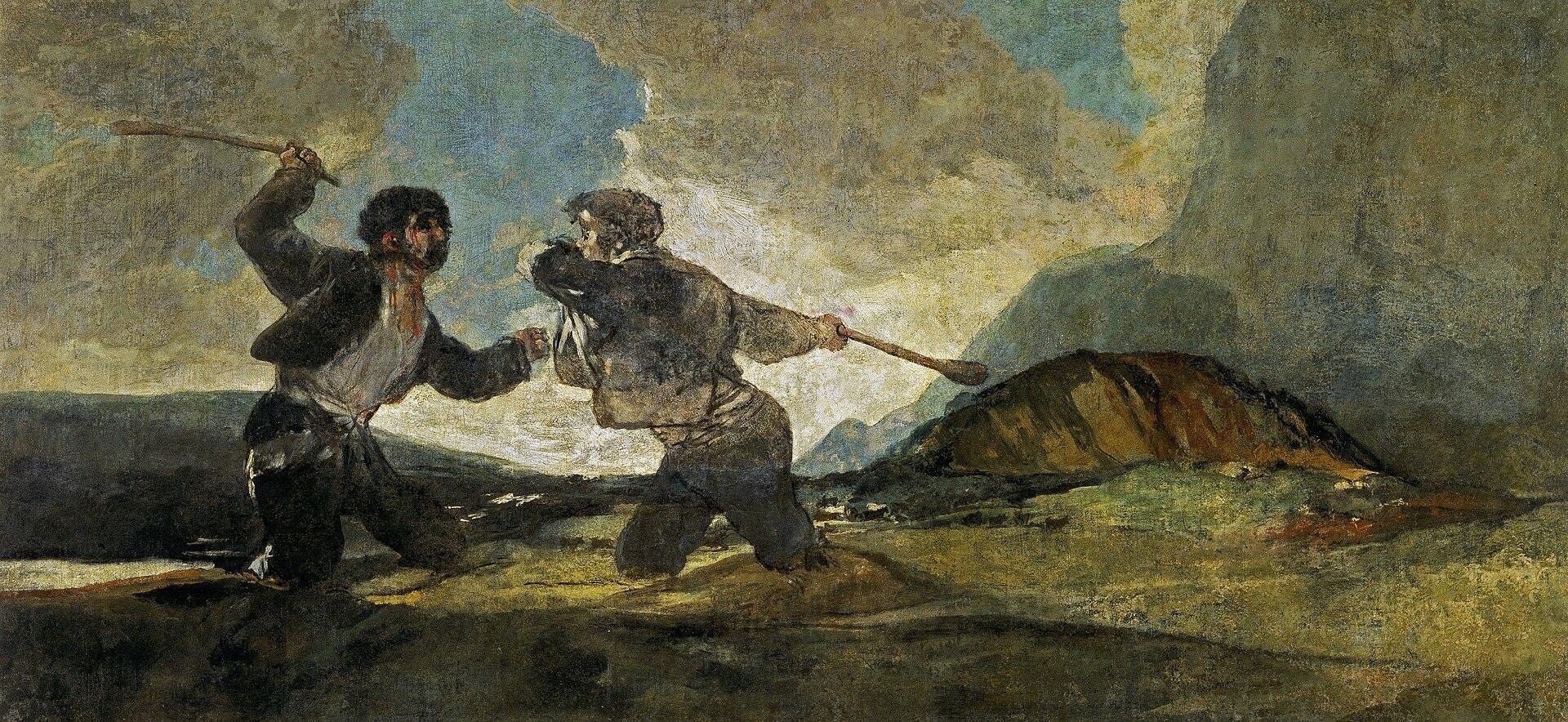
Nothing moved me that day. But I have since been moved by what transpired. In hindsight, it seems to me that I didn’t converse with my friend at all. All I did was talk past him, and in doing so wasted both my time and his. And yet such pointless engagements are by no means confined to our private lives. They happen all the time at the societal scale. Think of the rise and fall of the New Atheists, for instance. Much of it now seems like a pointless fever dream. An utter failure of a movement that died because it chose to repeat the obvious, ad nauseam. But why? Why did it choose to do that? And why do we?
Scott Alexander suggests that this has little to do with the content of what’s being said. For him, the New Atheists were offering a new hamartiology more so than a new argument. In other words, they were offering an alternative account of what’s wrong with the world. “It’s religion! That’s what makes people stupid and cruel, you see. Remove it and we can finally have decency!” Except that we didn’t. Instead we ended up spitefully repeating the same insipid message until a different hamartiology (woke) arose.
Such hamartiologies begin, I suspect, with the kind of individual disputes this essay opened with. We are ‘thrown’ into this world, to borrow from Heidegger here, alone like everybody else, and much of what we find here is difficult and does not make sense. Out of that emerges the urge to explain it. And it is always quicker to suppose that the world, or someone in it, has gone wrong than that we have misunderstood. And so we find ourselves pointing fingers at each other. Especially in arguments, where the urge to talk past one another is often overwhelming. And it feels good to blame. It feels good to think of ‘the Other’ as stupid, since that is all the excuse we need to see him as a threat and close ourselves off.
An obvious objection here can be raised. It can be argued that I have only described and problematised bad arguing, and that a good argument, properly made, ought still to move a reasonable person. However, in ‘Epistemic Learned Helplessness’ Scott describes reading Velikovsky’s pseudohistory as a young man and being convinced; reading the rebuttals and being convinced; reading the rebuttals to the rebuttals and being convinced again, “until the labyrinth of doubt seemed inescapable”. What got him out was noticing that several cranks flatly contradicted one another and yet were equally persuasive. So being unable to refute someone tells us almost nothing. As he puts it, “if I know that a false argument sounds just as convincing as a true argument, argument convincingness provides no evidence either way.” His practice now is to “nod, say that your argument makes complete sense, and then totally refuse to change” his mind. Which is near enough what my Catholic friend did. Isn’t it?
My friend, then, was not being as dogmatic as I would have liked to think. In his ‘Concept-Shaped Holes Can Be Impossible To Notice’, Scott Alexander argues that we can be missing a concept entirely and never know. One of his cases is a person who reached college before discovering they had no sense of smell, having spent years teasing their sister about her stinky feet. “You can talk to an anosmic person about smell for years on end,” Scott writes, “and they’re still not going to realize they’ve got a big hole where that concept should be.” If that can happen with smell, it likely can with much else. If so, a person who sounds to us to be talking nonsense may be reporting something we have no conception of. And in such a situation, given that we are tied to our own experience—our own concepts and holes—I don’t see any way of coming to terms with our interlocutors and avoiding dialectical stalemate, or worse, the urge to speak spitefully past one another. Well, no way except, perhaps, to set up the preconditions necessary for the persistence of dialectic.
This cannot be a matter of what we affirm, since, as has been argued, we can’t affirm with certitude. Affirmation gives us little anyway, since things share many of their attributes with one another; to call a thing red or round is to say what it has in common with a great many others. We can, however, negate. A thing is what it is by virtue of what it is not. So we come to know it less by naming what it is than by ruling out what it is not; for, as Sherlock Holmes puts it, “when you have eliminated the impossible whatever remains, however improbable, must be the truth.”
The same holds for the people we argue with. We may never be able to say with certitude what they mean, but we can, with them, progressively negate what they could not possibly mean. To negate in this way is to take a decisively apophatic posture and say, with Socrates, “I know nothing!” Such an approach enables us to be open to dialectic with anyone, on anything, until we come to terms with them. And if we don’t, we can at least avoid talking past them and wasting our lives away.
We would be like sculptors who set out to carve a statue.
They remove every obstacle to the pure view of the hidden image,
and simply by this act of clearing aside they show up the beauty which is hidden.
— Pseudo-Dionysius, Mystical Theology II —
Bibliography:
Alexander, Scott. “Concept-Shaped Holes Can Be Impossible To Notice.” Slate Star Codex, 2017. https://slatestarcodex.com/2017/11/07/concept-shaped-holes-can-be-impossible-to-notice/
Alexander, Scott. “Epistemic Learned Helplessness.” Slate Star Codex, 2019. https://slatestarcodex.com/2019/06/03/repost-epistemic-learned-helplessness/
Alexander, Scott. “New Atheism: The Godlessness That Failed.” Slate Star Codex, 2019. https://slatestarcodex.com/2019/10/30/new-atheism-the-godlessness-that-failed/
Dostoevsky, Fyodor. The Brothers Karamazov. Trans. Constance Garnett. London: William Heinemann, 1912.
Doyle, Arthur Conan. The Sign of Four. London: Spencer Blackett, 1890.
Heidegger, Martin. Being and Time. Trans. John Macquarrie and Edward Robinson. London: SCM Press, 1962.
Plato. Apology.
Pseudo-Dionysius. “The Mystical Theology.” In The Complete Works. Trans. Colm Luibhéid. New York: Paulist Press, 1987.