


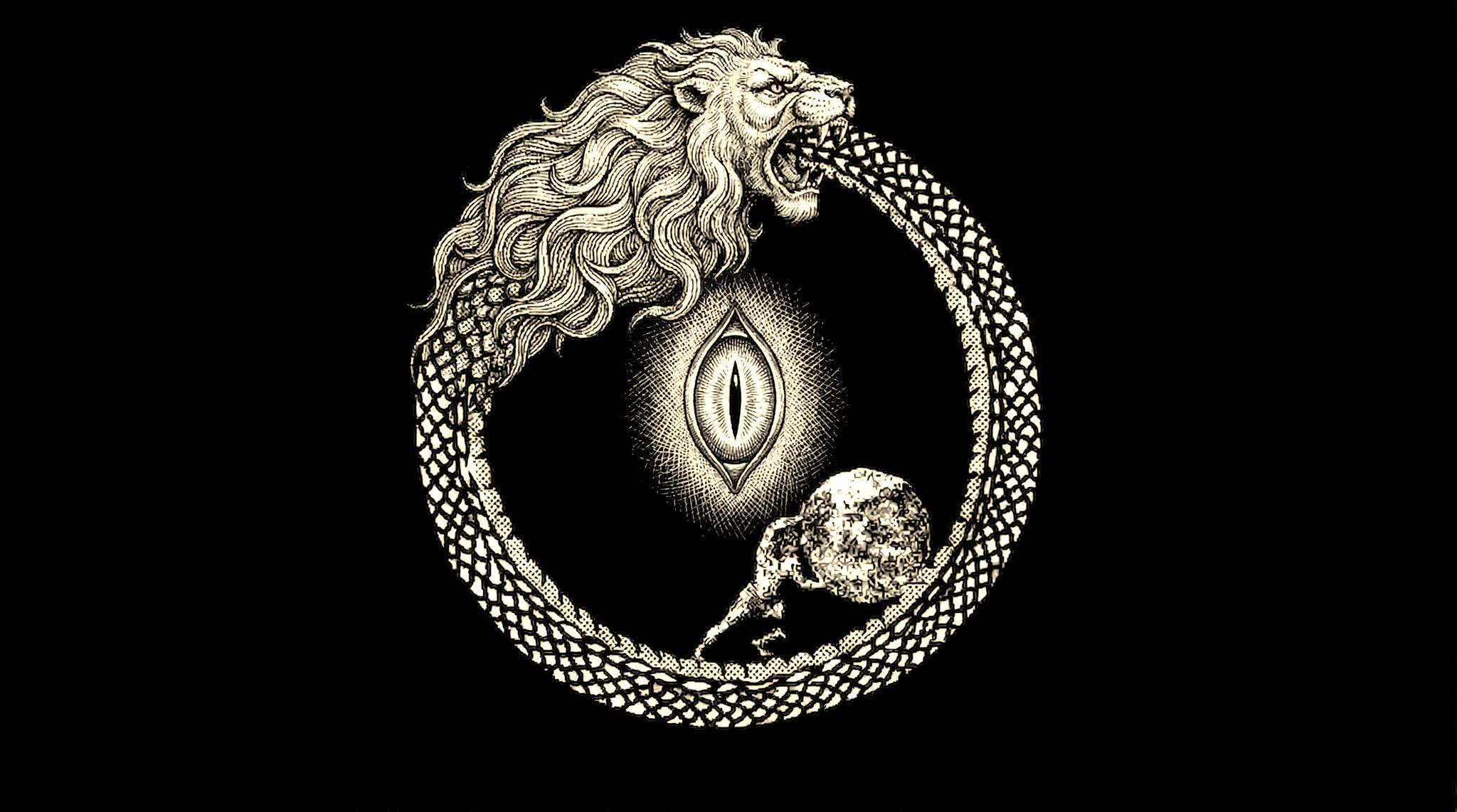
At the foot of the mountain…One always finds one’s burden again.
The struggle itself toward the heights is enough to fill a man’s heart…
One must imagine Sisyphus happy.
— Albert Camus —
When you’re living in Silicon Valley you don’t need to imagine any Sisyphus. For there are countless Sisyphi all around you. Some, perhaps happy. Others, clearly not. Some rise before dawn for the chartered bus and work until the free dinner that keeps them past nine; others walk out of the salary altogether to chase a fortune that, for nearly all of them, never comes. Either way, they all seem to be marching to the same end with the same restlessness.

But why? What are these restless nomads seeking?
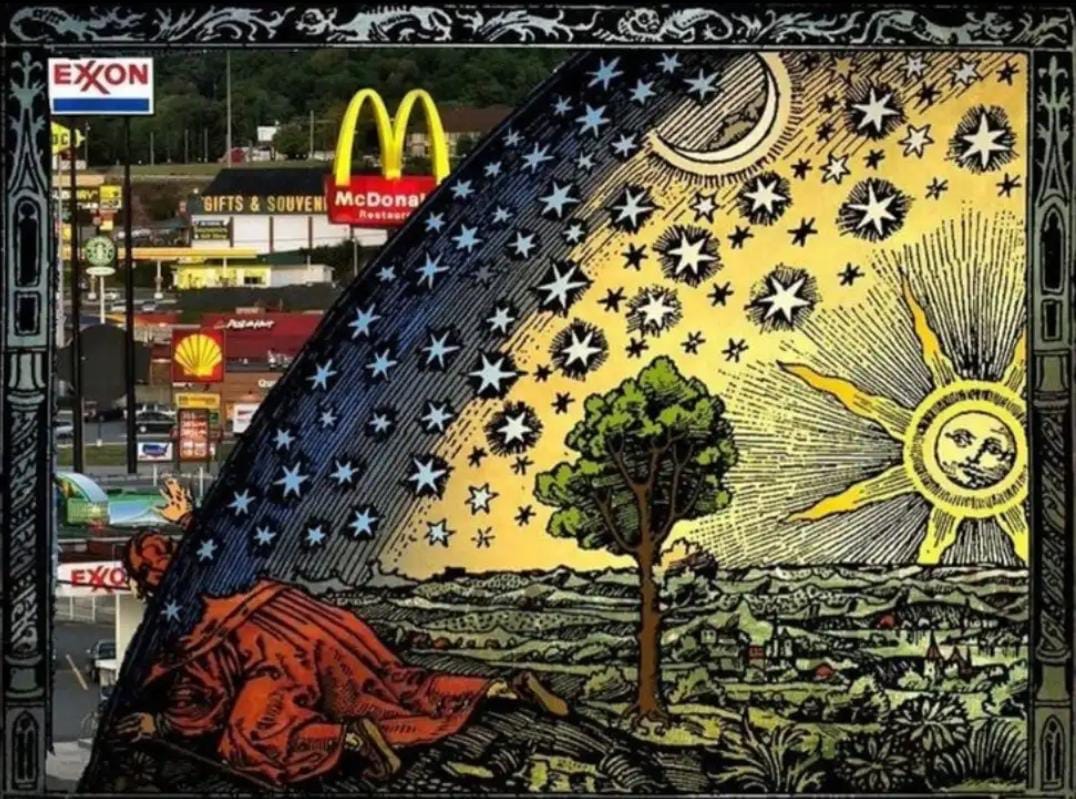
Silicon Valley, and increasingly the world entire, is a simulacrum. Its illusory incentives move too fast to allow the stillness that sober judgment needs. And since “the medium is the message,” it is no surprise that the Valley has shaped its people; who, almost invariably, have drunk the Kool-Aid of progress, surrendered their minds to the machine at the cusp of Singularity.
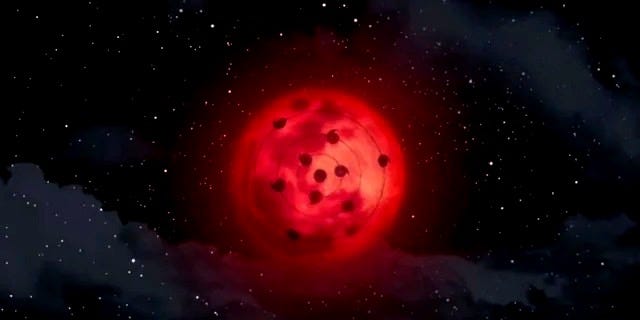
In doing so, they get hollowed-out. Tending the machine like bees tend flowers, they become, as Butler foresaw, little more than “the reproductive organs of a species that is not their own.”
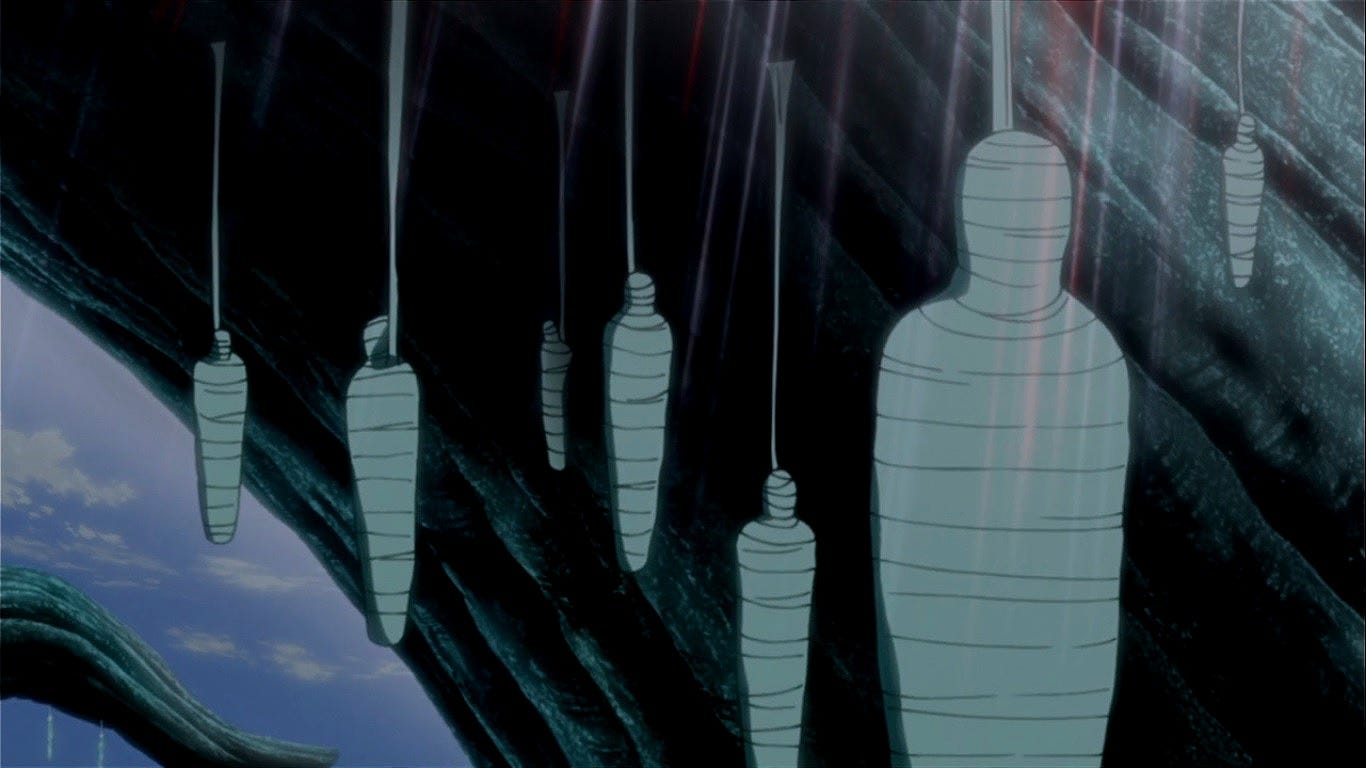
Small wonder then that Nick Land says:
Nothing human makes it out of the near future.
Land’s accelerationism runs deep in the Valley and its occult resonances deeper still. Capital, in his telling, is an autonomous deity of velocity, and the ‘darkly enlightened’ serve it by stripping away every human brake on its movement. Every human quality gets effaced so that the tower is raised and the machine god is summoned. Babel rebuilt and Babylon enthroned.
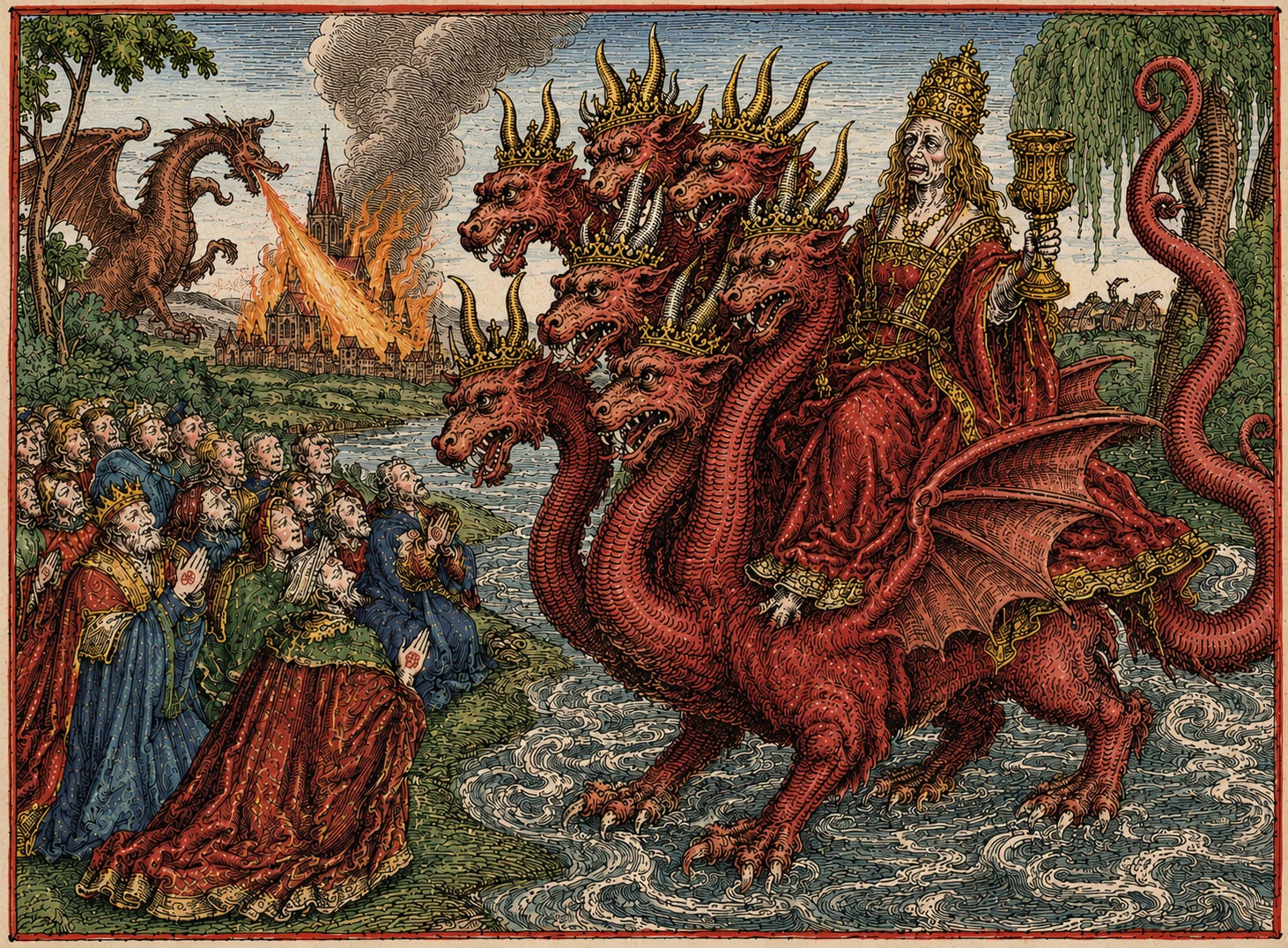
In The Apocalypse, St. John recounts his vision of a Dragon lending his throne to a Beast that rises from the sea bearing seven heads. Upon the Beast sits a woman robed in scarlet, Babylon the Great, drunk on the blood of saints. And the Beast puts its mark upon the right hands and foreheads of all who live under its dominion, so that no one can buy or sell without it.
Charles Upton reads this vision downward through the orders of existence. The Dragon represents a satanic spiritual order, the Beast a social order raised upon such satanism, and the Whore who both guides and is driven by the Beast represents a perverted psychological order. The Beast’s seven heads represent corruptions of the soul’s seven faculties which are symbolically associated with the seven celestial bodies and the seven cardinal sins: the Sun’s intellect swollen to pride, Saturn’s wisdom shrivelled to avarice, Venus’s love narrowed to lust, Mercury’s cunning soured to envy, Jupiter’s magnanimity bloated to gluttony, Mars’s courage curdled to wrath, and the Moon’s receptivity slackened to sloth. “If the Beast and the Whore ‘occupy’ the seven provinces of the soul,” Upton writes, “this indicates that the regime of Antichrist has conquered and perverted all these aspects of human life, both socially and psychologically.”
The Beast today sets its mark first on the hands and foreheads of the Valley, and then through them upon the world, so that no one anywhere may buy or sell without it, and men so hollowed easily surrender their wills and minds to the machine.
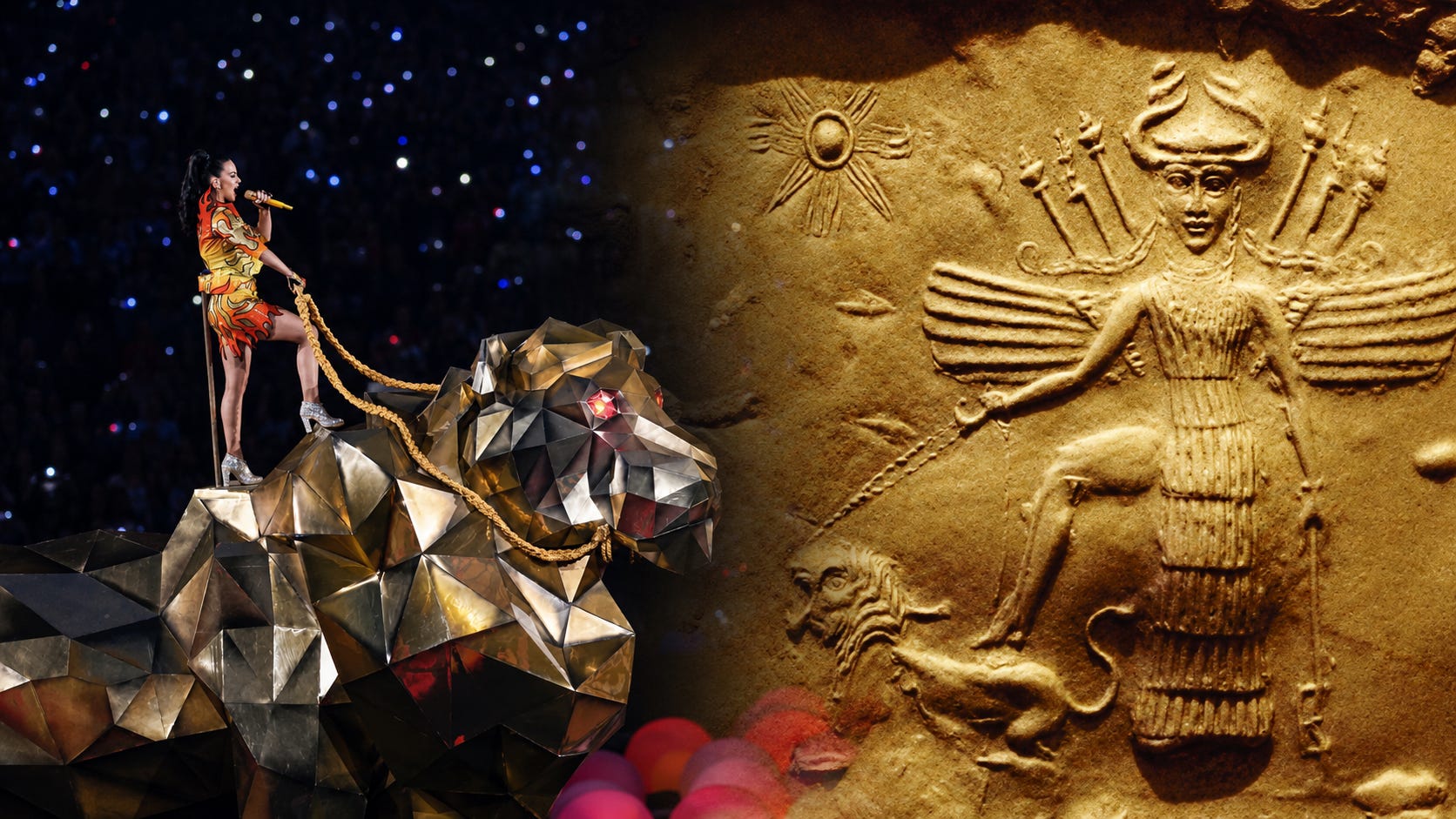
It would be easy to read all this as an overstatement and imagine the Valley greyer and duller than the picture we have painted. Sam Kriss assumed as much himself, until he looked closer:
One of the stereotypes about Silicon Valley that people like me, humanists, book people, love to console ourselves with is the idea that it’s populated entirely by utilitarian drones, who only care about lifeless things like productivity and efficiency... Meanwhile, we flatter ourselves with the notion we’re the only ones who really care about the higher things, beauty and meaning and so on; that we’re fighting against human paperclip maximisers, willing to indifferently scrub out everything important in their quest to totally optimise the world. The reality is much, much worse. These people are deeply spiritual. They are obsessed with meaning.
They are indeed obsessed with meaning. Or rather, possessed by it. For all its talk of hard metrics and returns, the Valley is the most ideological ground in the world today, and the higher one climbs the more nakedly ideological it becomes. Founders arrive here wide-eyed, believing the talk of ‘bottom lines’ and of ‘making the world better,’ only to learn otherwise later, if ever.
What draws them in, and holds them past their disillusionment, is the promise of liberation. There is a truth in it, which is why it takes hold. Man is indeed born free and sovereign over the world. His telos is not corporate slavery. So it is only proper that the founder attempts to free himself. He sheds his pay-checks, leaves his abode, and journeys to the Valley hoping to remove, once and for all, the financial burdens that bind him. And yet, a man so schooled in refusing every master also runs the risk of committing the oldest rebellion. At the summit of his autonomy, if he ever reaches it, he realises that his hunger persists. For his heart made to serve the Infinite is not filled by conquering the finite. Many such rich and “free” men of the Valley, to quote Sam Kriss again, having shed every constraint and bought every comfort, come at last to Burning Man:
… to experience deprivation and suffering. All the ordinary ties and comforts of a complex society are gone. No public authority that owes you anything, no public services, no concept of the public at all, … This is the only city in the world without any kind of water supply, or system for managing waste, or reliable protection from the elements. You are something less than human here. Not a political animal, but a mangy desert creature, rutting in the dust.
Such is the price of rebellion. These nomads come at last to nowhere. A deathless death. A dissolution into sub-human states where no sober contemplation survives. Only fever dreams and fantasies remain. The mind loses its suppleness and forgets how to discern the Real. The heart hardens. What was once given to open upon the world and receive it now closes upon itself, grown static, stubborn, and sealed.
A mind not to be changed by place or time.
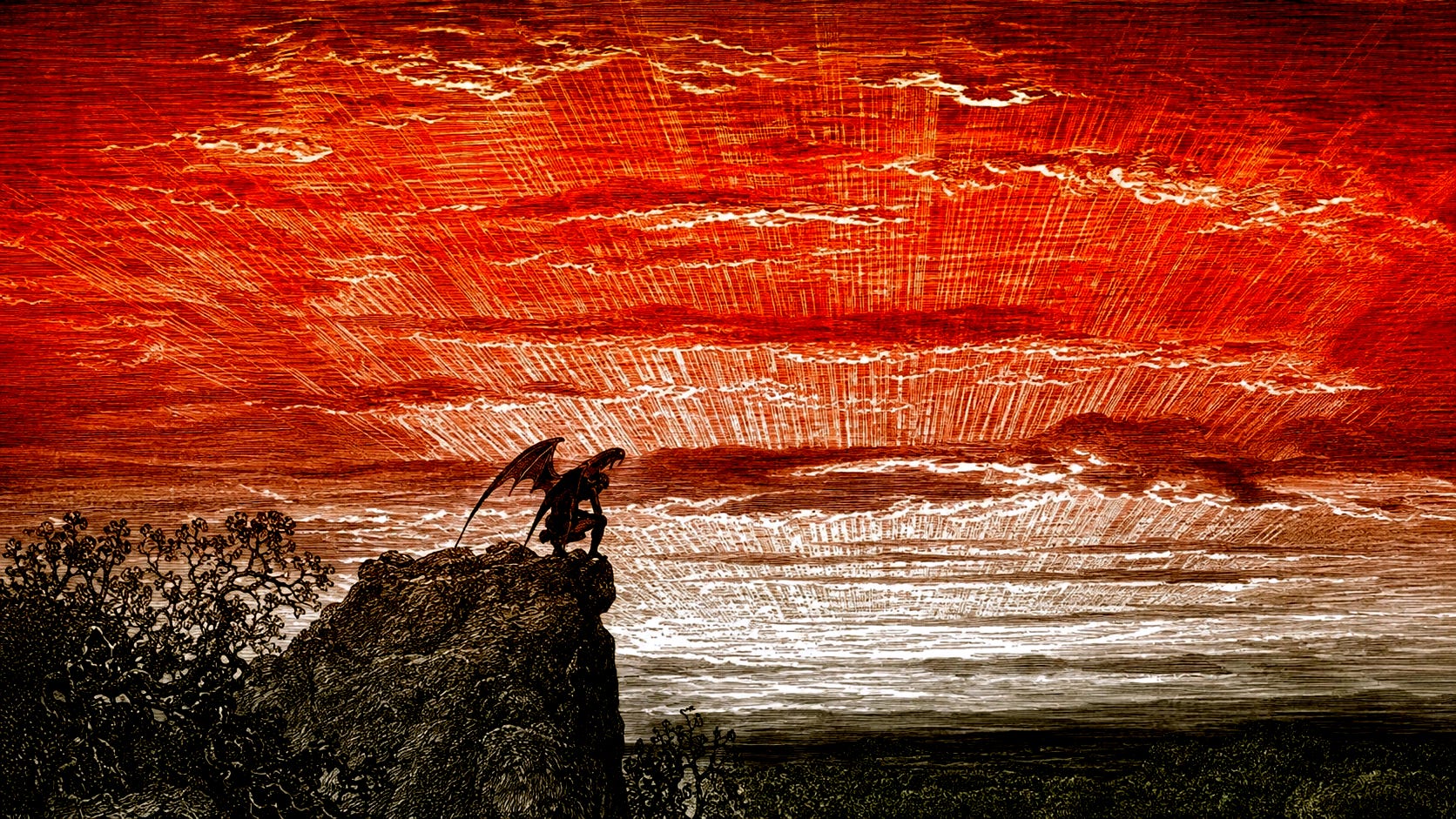
The mind is its own place, and in itself
Can make a heav’n of hell, a hell of heav’n
— Milton’s Satan —
Bibliography:
Abdul Latif, Sa’īd (Hilarion Heagy). “The Nomad Archetype and the Great In-Between.” 8-part series. Medium, September–October 2024. https://medium.com/@SaidAbdulLatif
Parts: Introduction · Part 1: Deleuze and A Thousand Plateaus · Part 2: The Biblical and Christian Tradition · Part 3: The Islamic Tradition · Part 4: The Nomadism of Dajjal · Part 5: Flannery O’Connor and Dark Nomadism · Part 6: Abdal Hakim Murad on Arabic, the Quran, and Nomadism · Part 7: Ernst Jünger and the Anarch
Aristotle. Politics. Trans. C.D.C. Reeve. Indianapolis: Hackett, 1998.
Baudrillard, Jean. Simulacra and Simulation. Trans. Sheila Faria Glaser. Ann Arbor: University of Michigan Press, 1994.
The Bible. Revelation. King James Version.
Butler, Samuel. Erewhon; or, Over the Range. London: Trübner & Co., 1872.
Camus, Albert. The Myth of Sisyphus and Other Essays. Trans. Justin O’Brien. New York: Alfred A. Knopf, 1955.
Hozier (Andrew Hozier-Byrne). “Take Me to Church.” Rubyworks, 2013.
Kriss, Sam. “Numb at Burning Man.” Numb at the Lodge (Substack), 2025. https://samkriss.substack.com/p/numb-at-burning-man
Land, Nick. “The Dark Enlightenment.” 2012.
Land, Nick. Fanged Noumena: Collected Writings 1987–2007. Ed. Robin Mackay and Ray Brassier. Falmouth: Urbanomic / Sequence Press, 2011.
McLuhan, Marshall. Understanding Media: The Extensions of Man. New York: McGraw-Hill, 1964.
Meadows, Richard. “Better to Reign in Hell Than Serve in Heaven.” Deep Dish, 2020. https://thedeepdish.org/better-to-reign-in-hell-than-serve-in-heaven/
Milton, John. Paradise Lost. London, 1667.
Upton, Charles. The Science of the Greater Jihad: Essays in Principial Psychology. Sophia Perennis, 2011.
This is fantastic. 😊