


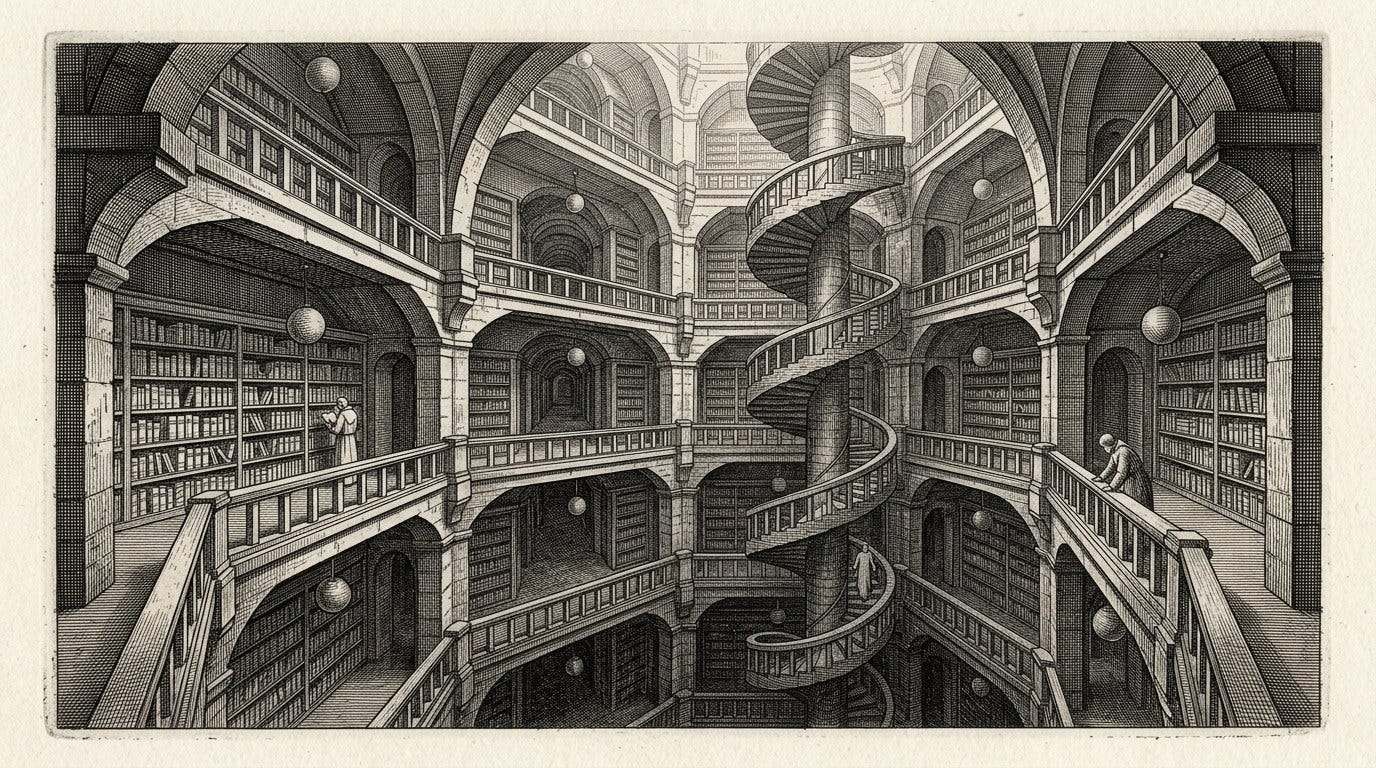
In his short story The Library of Babel (1941), Borges describes a world in which the protagonist finds himself inhabiting an indefinite library. The library comprises shelves upon shelves of books where each book is a unique permutation of symbols from a finite alphabet. Every possible permutation, somewhere within those interminable book-shelves, already exists. The library is total; and yet, precisely because it is total, it yields nothing. The books are, in their overwhelming majority, gibberish. Mere concatenations of opaque symbols. There is no hidden cipher, no book of books that unlocks the rest, no centre from which meaning radiates outward. Men, trudging through the library, go mad wondering whether it is limitless or finite, why it exists at all, and whether there is a way out.
Read today, the story is an allegory for how we phenomenologically encounter the world we inhabit. Swamped by more than we could ever read, we meet the universe in fragments and perceive it as a pointless accumulation of ultimately absurd symbols. Time too, as it moves ever faster, seems to muffle and suffocate us. Angst, apathy, and anxiety are what condition our internality as we, like the librarians, find ourselves ferociously flung into a world ridden with Fanged Noumena.
Even so, Borges ends his short story with:
I dare insinuate the following solution to this ancient problem: The Library is limitless and periodic. If an eternal voyager were to traverse it in any direction, he would find, after many centuries, that the same volumes are repeated in the same disorder (which, repeated, would constitute an order: Order itself). My solitude rejoices in this elegant hope.
A poignant hope indeed; for no traveller is eternal…
The story is worth reading.
lmk your thoughts if you guys get round to reading it!