


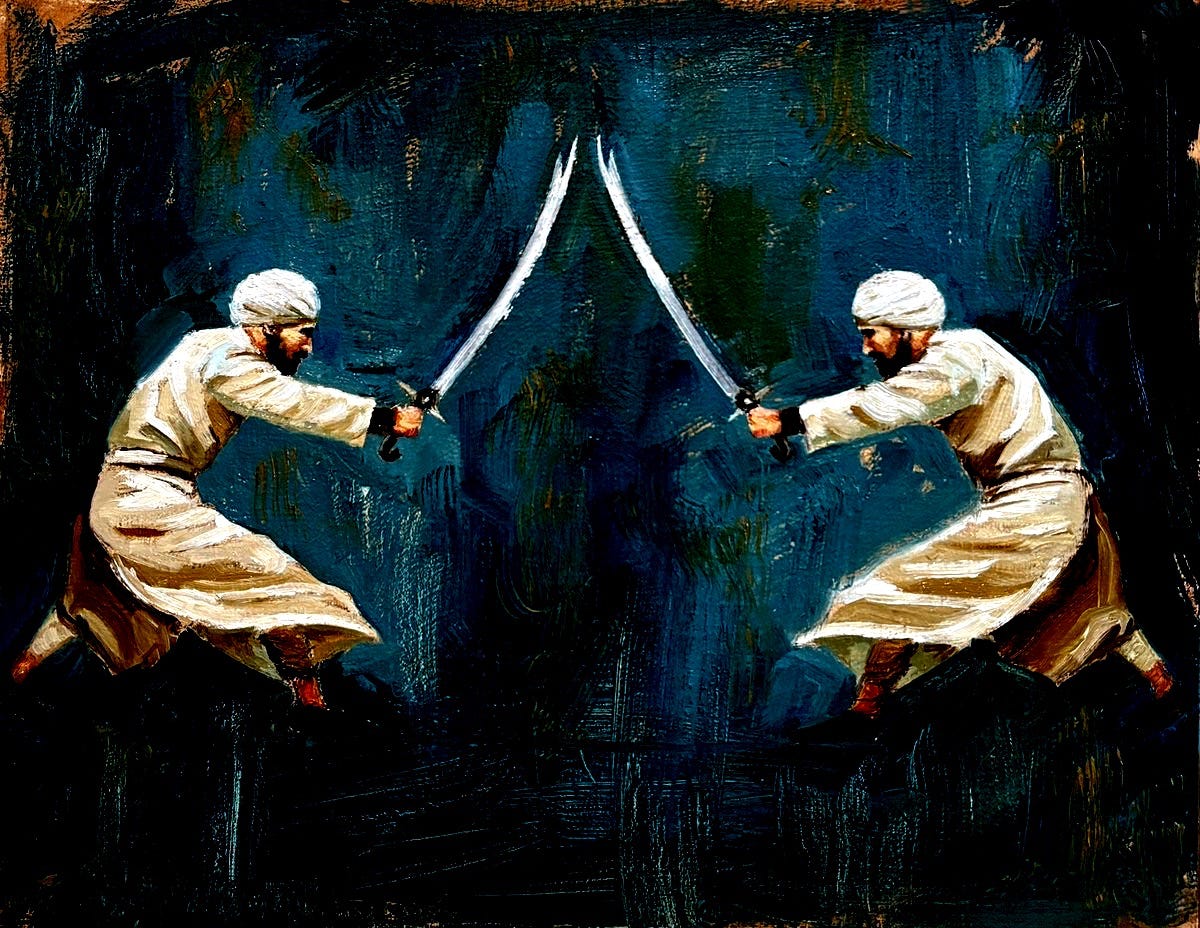
The Secret of thy Self: “no god but the One!”
Thy Self is a sword; whetstone? “no god but the One!”
— Iqbal —
In his Library of Babel, Borges describes a world in which the protagonist finds himself inhabiting an indefinite library. The library comprises shelves upon shelves of books where each book is a unique permutation of symbols from a finite alphabet. Every possible permutation, somewhere within those interminable book-shelves, already exists. The library is total; and yet, precisely because it is total, it yields nothing. The books are, in their overwhelming majority, gibberish. Mere concatenations of opaque symbols. There is no hidden cipher, no book of books that unlocks the rest, no centre from which meaning radiates outward. Men, trudging through the library, go mad wondering whether it is limitless or finite, why it exists at all, and whether there is a way out.
Clearly, this is an allegory for how the modern man phenomenologically encounters the world he inhabits. Fallen as he is, he casts the universe in his own fragmented image and perceives it as a pointless accumulation of ultimately absurd symbols. Time too, as it moves ever faster, seems to muffle and suffocate him. Angst, apathy, and anxiety are what condition his internality as he finds himself ferociously flung into a world ridden with Fanged Neumena.
Even so, Borges ends his short story with:
I dare insinuate the following solution to this ancient problem: The Library is limitless and periodic. If an eternal voyager were to traverse it in any direction, he would find, after many centuries, that the same volumes are repeated in the same disorder (which, repeated, would constitute an order: Order itself). My solitude rejoices in this elegant hope.
It is with such elegant hope in the orderedness of existence, coupled with the certitude of a traditional man, that Martin Lings, analogising between the microcosm (man) and the macrocosm (cosmos), writes: “The mellowing of spirituality, which is the highest aspect of old age in itself, is thus crowned with illumination which belongs more to youth than to age…analogously, in the macrocosm, the nearness of the new Golden Age cannot fail to make itself mysteriously felt before the end of the old cycle.”
Such hope, however, must be tempered with the sobriety with which Guenon writes:
We are entering upon a period when it will be extremely difficult to ‘separate the grain from the chaff’ … because of the general confusion manifesting itself in intensified and ever more varied forms … We shall see whether the subtleties of dialectic are of any avail in such circumstances, and whether any philosophy, even were it the best possible, can have the strength to prevent the ‘infernal powers’ from being let loose … and turn the contemporary mentality away from its deviation.
Even so, to quote Lings again, “If human societies degenerate on the one hand with the passage of time, they accumulate on the other hand experiences in virtue of old age.” Analogously, from the microcosmic perspective, “there is a mode of wisdom which belongs to old age in particular, and which is even susceptible of being assimilated, to a certain degree, by those who were not wise in youth and middle age.” As such, from the macrocosmic perspective, the Spirit of our times has “something positive to offer which is characteristic of no previous era.”
What, then, keeps us from assimilating the positives that our age uniquely offers? The following passage, penned by Gai Eaton, may prove to be instructive here:
The Christian world has known the legend of that ‘innocent’ bystander who, when Christ passed with his Cross, called out: ‘Get on with you! Go faster!’ and was therefore condemned to roam the earth until the Day of Judgment, homeless and rejected by all men. How was he to know that this scourged criminal was the Christ? How can we expect the average man to be so constantly on the alert that he is ready for the moment when Reality breaks through the carapace of time like lightning from heaven? But our incapacities are not, though we like to think them so, the measure of all things; and when the harmless little man who lives decently enough in the familiar shadows of the normal world finds himself suddenly in the full blaze of sunlight, he stumbles against the adamantine rock and is broken.
The bystander had a responsibility and he abdicated it. His lack of openness to the possibility of being utterly mistaken and delusional is not as innocent as we may want it to be. To make man the measure of all things is not a neutral philosophical posture. It is arrogant foreclosure to dialectic; and hence, to Truth.
Modern man, instead of attempting to raise himself to Truth,
seeks to drag Truth down to his own level.
— Guenon —
That such an arrogant disposition is not normally struck down by life does not diminish its enormity any more than His Mercy renders His Wrath ineffectual. The modern world is hell-bent (literally) on cultivating and rewarding such arrogance. It occupies us so swiftly with such self-centered distractions that “when Reality breaks through the carapace of time” we are, at best, not there to meet It; or, at worst, ready to spit in Its Face.
And yet, paradoxically, the swiftness of this age which pacifies and forecloses us also contains within it the possibility of active radical openness. The same macrocosmic acceleration that overwhelms the passive can propel the active. The absurd accumulations of The Eleventh Hour can be alchemised into knowledge; but there’s much unlearning that we must first do.
If the nature of this age is to stagnate, we must choose to be Dionysian. Our posture must be apophatic, less a grasping than a relinquishing. And this openness, by its very nature, would place us exactly where we ought to be. That is, nowhere in particular. Squarely in the Great In-Between.
Bibliography:
Abdul Latif, Sa’īd (Hilarion Heagy). “The Nomad Archetype and the Great In-Between.” 8-part series. Medium, September–October 2024. https://medium.com/@SaidAbdulLatif
Parts: Introduction · Part 1: Deleuze and A Thousand Plateaus · Part 2: The Biblical and Christian Tradition · Part 3: The Islamic Tradition · Part 4: The Nomadism of Dajjal · Part 5: Flannery O’Connor and Dark Nomadism · Part 6: Abdal Hakim Murad on Arabic, the Quran, and Nomadism · Part 7: Ernst Jünger and the Anarch
Borges, Jorge Luis. “The Library of Babel.” In Ficciones. Trans. Anthony Kerrigan. New York: Grove Press, 1962.
Eaton, Charles Le Gai. King of the Castle: Choice and Responsibility in the Modern World. Cambridge: Islamic Texts Society, 1977.
Frost, Robert. “The Road Not Taken.” Mountain Interval. New York: Henry Holt, 1916.
Guénon, René. The Crisis of the Modern World. Trans. Arthur Osborne. London: Luzac & Co., 1942.
Iqbal, Muhammad. “La ilaha illAllah” (Zarb-e-Kalim, poem 5). 1936.
Land, Nick. Fanged Noumena: Collected Writings 1987–2007. Ed. Robin Mackay and Ray Brassier. Falmouth: Urbanomic / Sequence Press, 2011.
Lings, Martin. The Eleventh Hour: The Spiritual Crisis of the Modern World in the Light of Tradition and Prophecy. Cambridge: Archetype, 1987.