


Moments passed so long from the moment I laid eyes on You
Never made it back home from the moment I laid eyes on You
— Accountable, Amtrac —
A video went quite viral recently. It showed a solitary penguin heading neither to its colony to procreate, nor to the sea for its sustenance; but straight to certain death in the mountains. “But why?” asks the perplexed narrator in the video, along with millions of equally perplexed viewers on X. People then proceeded to interpret the penguin’s quest in a variety of ways. Some deemed it depressed. Others heroic. Yet others pretentiously accused everyone else of anthropocentrism. Whatever one may make of the penguin, its quest certainly speaks to us. It speaks to something within us that is deeply human.
But what is it? What is the nerve in us that resonates with a creature waddling away from everything that constitutes ordinary flourishing toward something unnamed and unreachable? For Levinas, the name of this nerve is metaphysical desire. Unlike ordinary desire, which springs from a felt lack in the self and aims at a specific, consumable other, which when obtained quenches the longing; the metaphysical desire neither arises from lack nor aims at anything that can be possessed or consumed. Rather, it springs from the plentitude of the human heart, carved on which is an infinitesimal trace of the Infinite, and then moves, beyond all satisfaction, with an intensity which increases perpetually.
The Eyes sought to see, even as they saw
As this cold heart warmed it beat even more
— Inspired by Iqbal —
If this is so, if indeed the human heart seeks the Infinite; and, most deeply, nothing but the Infinite, why don’t we all ‘migrate to the mountains?’ How is it that a desire constitutively oriented toward the Absolute is so routinely distracted by what is manifestly not Absolute? Surprisingly, on the road of Longing for the Other, much like the penguin, it’s the feeding waters and the colony that distract us.
Actions are by their intentions, and every person shall have only what he intended. He whose migration was for God and His Messenger, his migration was for God and His Messenger; and he whose migration was for worldly gain or for a woman he wished to marry, his migration was for that to which he migrated.
— The Chosen One —
The Prophet’s migration was not toward a pre-existing sanctuary (dār al-islām). Like his grandfather Abraham, he stepped into the unknown for the sake of the Other alone.
Abrahamic sight though is difficult to cultivate
Lustful hearts too often ‘imagine’ and deviate
— Iqbal —
Such selfless search for the Other is rare indeed. Too often the self, as it steps into the unknown, rather than praying like the prophet for discernment — “My Lord, show me the Reality of things as It is” — falls prey to imagining the Other in its own image. That’s why Amīr Khusrow warns not to lustfully step into ‘the way,’ for the way is truly precarious as two errors lie in ambush.
The first, hardens the distinction between the self and the Other into an irreconcilable opposition. Subject here, object there, an unbridgeable Cartesian chasm between them. The world is thus reduced to a field of opaque, mute things that yield no meaning. This Dualism is an anti-traditional posture that mistakes the relative for the absolute. The opposition between knower and known is real enough from a certain vantage, but to treat it as final is to foreclose the possibility of passage. And what does such foreclosure look like, phenomenologically? It looks like Borges’ Library: a world of opaque, self-referential symbols that disclose nothing. Shelves upon shelves of gibberish. It looks like the hollowing out of the symbols that surround us, leaving behind empty shells which we may call apotypes: symbols that signify nothing.
The second error, what we may term Monism, attempts to overcome the opposition by reducing one of the two terms into the other. Either the self devours the Other, assimilating everything foreign into its own categories, or the self suicides before an Other so totalising that nothing of the subject survives. Both moves claim to resolve the tension, but both merely suppress one of its poles. And what is suppressed invariably returns distorted. This is the inversion of the symbol which now points actively downward toward, what we may call, its hypotype: the simulacrum, the effigy, the Fanged Noumenon. Where the apotype merely deadens, this inversion actively seizes the symbol and presses it into the service of what Guénon calls the counter-tradition: a spiritual operation in reverse, exploiting the same openness that makes genuine initiation possible.
The root of both errors is the limitation to a subject-object mode of perception which results in the dyad ‘me and my world’ and veils us from the archetype to which this dyad points; namely, God and His self-knowledge which, ultimately, are One. When our primal fears and desires make us forget this we begin seeing shadows where there is nothing but “Light upon light.”
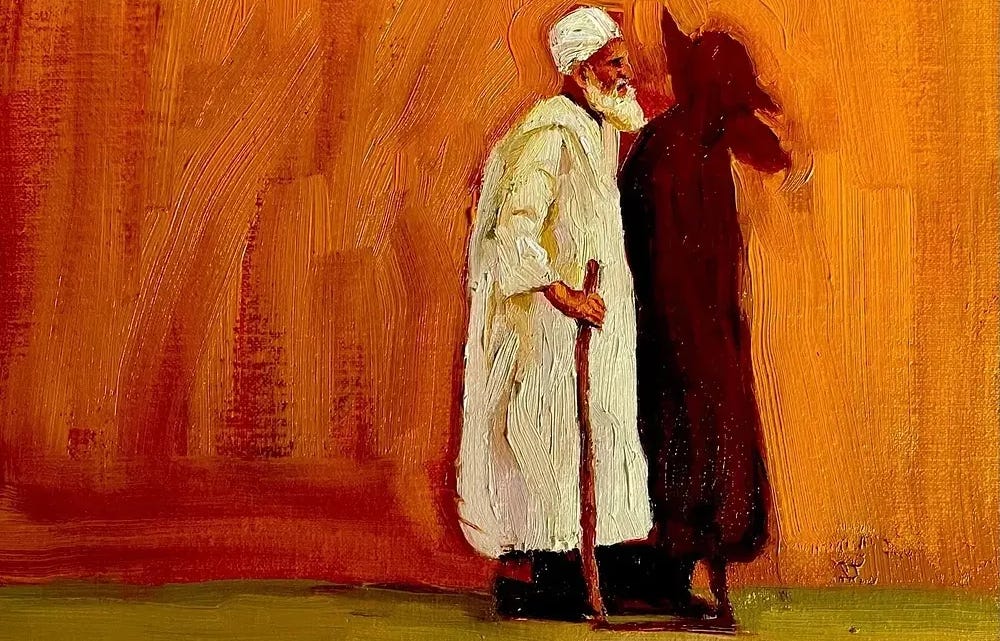
A shadow requires three things: a source of light, an opaque object, and a field where the shadow falls. If the light is God, the opaque object, the ego, and the field where the shadow falls, the universe, then the shadows of the ego, projected by the Divine Light, are false beliefs, which appear to that ego not as its own shadows, nor even as beliefs, but as the literal nature of reality: the shadows of God.
— Charles Upton —
The two errors cast two shadows each. The dualistic attitude construes the world as opaque and meaningless making the self subject to an ultimately arbitrary Fate. When confronted with this Fate, the self seeks to impose on the world some external order; namely an unduly totalising Law. Invariably, such law breeds Chaos; and the self, threatened by Chaos, inflates into a Selfhood that seeks to devour the world entire. Thus are Monism’s two shadows born. In such wise, to use Upton’s terms, the four archons emerge — Fate, Law, Chaos, and Selfhood — each a shadow of an error, all colluding under the command of a single orchestrator.
Then I [Satan] will come to them from before them and from behind them and on their right and on their left, and You will not find most of them grateful.
— Quran 7:17 —
The two errors, and their four shadows, accompany the nomad at every step in the Great In-between. And the In-between is no path between two fixed points; it, as Deleuze observes, “has taken on all the consistency and enjoys both autonomy and a direction of its own.” It possesses, in other words, its own momentum and offers to the nomad instead of a pleasantly paved path, a perilous fork-ridden road.
Two roads diverged in a yellow wood
And sorry I could not travel both
And be one traveller, long I stood ...
Yet knowing how way leads on to way ...
I took the one less traveled by
And that has made all the difference.
— Robert Frost —
Way leads on to way. At each fork the same liminal openness that makes authentic encounter with the Other possible also makes distortion and inversion possible. Depending on the subjectivity of the one who stands in this space, the orientation of his desire, the quality of his inner eye, the symbols he encounters will disclose themselves differently. This is why the apophatic posture described earlier, less a grasping than a relinquishing, must be perpetual. The great inbetween does not permit a single decisive act of openness followed by coasting. He who treads the pathless path does not drift into it. He chooses it, repeatedly, and at considerable cost.
Such perpetual openness can only emerge from a non-dualistic posture. A posture that recognises that terms under opposition find their resolution in a higher, more universal, principle. The self, in such a posture, can be genuinely at ease in the unknown because it recognises that “all knowledge is remembrance;” and that the Other, in a sense, is already intimately known.
I have made him and have breathed into him of My Spirit.
– Quran 15:29 –
We are nearer to him than his jugular vein.
– Quran 50:16 –
This is the Abrahamic way: to step into the unknown, trusting that what calls from beyond the horizon is not alien to what beats within the breast. The symbol, encountered in this mode, is neither hollow nor inverted. It is alive and points beyond itself towards the Real, participating in the archetype it signifies and transparent to the Light behind it. It is like the sacramental morsel of Ibrahim Qanduzi: an ordinary thing, dry bread and a toothless old mouth, through which the Infinite breaks forth.
God is the Light of the heavens and the earth.
– Quran 24:35 –
The Sufis know well that life is a constant movement through stages, the maqāmāt and aḥwāl, none of which constitute a final resting place, each of which is a preparation for the next. Intimation of the next stage is a precondition of it. “Seek and ye shall find!” The subject already, in some latent yet real sense, stands in contact with what draws him forward. And this in-between that he traverses, the barzakh or isthmus, is the domain that stands between two orders of existence without collapsing into either. The domain of lived discernment between the symbol, its true meaning, and its distortions.
The great inbetween, then, is the liminal space of pure phenomenological possibility: the zone in which every symbol encountered in the passage of life may disclose itself as archetype, or hollow itself into apotype, or invert itself into hypotype, and everything in between, to the degree of the humility or apathy or arrogance of the one who encounters it. It is the theatre of a war that is waged in the innermost chamber of the desiring heart, at every fork on the unknown road.
Not all those who wander are lost. True.
But also: not all those who journey, arrive.
Bibliography:
Abdul Latif, Sa’īd (Hilarion Heagy). “The Nomad Archetype and the Great In-Between.” 8-part series. Medium, September–October 2024. https://medium.com/@SaidAbdulLatif
Parts: Introduction · Part 1: Deleuze and A Thousand Plateaus · Part 2: The Biblical and Christian Tradition · Part 3: The Islamic Tradition · Part 4: The Nomadism of Dajjal · Part 5: Flannery O’Connor and Dark Nomadism · Part 6: Abdal Hakim Murad on Arabic, the Quran, and Nomadism · Part 7: Ernst Jünger and the Anarch
Amir Khusrow, Dehlavi. “Bahut Kathin Hai Dagar Panghat Ki.” Geet [Hindavi devotional lyric]. In Kulliyat [Collected Works]. 13th–14th century.
Amtrac (Caleb Cornett). “Accountable.” Oddyssey. Openers / RCA Records, 2020.
Borges, Jorge Luis. “The Library of Babel.” In Ficciones. Trans. Anthony Kerrigan. New York: Grove Press, 1962.
Dalton, Drew M. Longing for the Other: Levinas and Metaphysical Desire. Pittsburgh: Duquesne University Press, 2009.
Deleuze, Gilles, and Félix Guattari. A Thousand Plateaus: Capitalism and Schizophrenia. Trans. Brian Massumi. Minneapolis: University of Minnesota Press, 1987.
Frost, Robert. “The Road Not Taken.” Mountain Interval. New York: Henry Holt, 1916.
Guénon, René. The Crisis of the Modern World. Trans. Arthur Osborne. London: Luzac & Co., 1942.
Iqbal, Muhammad. “Tulu-e-Islam” (Bang-e-Dra, poem 163). 1924.
Land, Nick. Fanged Noumena: Collected Writings 1987–2007. Ed. Robin Mackay and Ray Brassier. Falmouth: Urbanomic / Sequence Press, 2011.
Levinas, Emmanuel. Totality and Infinity: An Essay on Exteriority. Trans. Alphonso Lingis. Pittsburgh: Duquesne University Press, 1969.
Plato. Meno. Trans. G.M.A. Grube. In Plato: Complete Works. Ed. John M. Cooper. Indianapolis: Hackett, 1997.
Upton, Charles. The Science of the Greater Jihad: Essays in Principial Psychology. Sophia Perennis, 2011.